1

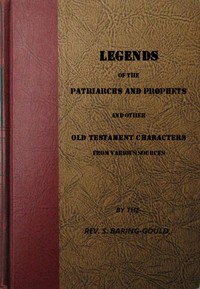
Legends of the Patriarchs and Prophets And Other Old Testament Characters from Various Sources — Reading Companion
3
1
Project Gutenberg
2015
Bible. Old Testament -- Legends
Readers of public-domain and historical texts
Project Gutenberg digital edition
en
Edition facts
Words: 152,494
Reading time: 664 min
Text sections: 20
Source:
Project Gutenberg record #48736
Sabine Baring-Gould's collection of Old Testament legends traces Jewish, Christian, and Islamic traditions from Adam to Joshua, drawing on Talmudic, apocryphal, and Persian sources. The preface classifies legends by origin—literalist misinterpretation, Cabbalistic letter-play, or genuine tradition—while the Melchizedek entry exemplifies the work's layered, scholarly voice and shifting pace between analytical commentary and narrative.
Editorial Edition Score
4.9/5
★★★★★
★★★★★
Calculated from edition completeness, EPUB availability, text structure and catalogue metadata. Not a user rating.
Edition quality
Sabine Baring-Gould’s Legends of the Patriarchs and Prophets opens with a preface that functions as a taxonomy of legend-formation. The author distinguishes four classes of Jewish tradition: those derived from Persian sources (like Asmodeus), those from Cabbalistic letter-permutation, those from Rabbinic literalist readings of poetic figures, and a small residuum of “genuine tradition.” This analytical framework sets a deliberate, scholarly pace before the entries themselves shift into narrative mode. The Melchizedek section, for instance, moves from a dense theological discussion of his genealogy to a quoted apocryphal account that unfolds as a dramatic scene—Abraham crossing the Jordan, Melchizedek bearing bread and wine. The alternation between critical commentary and storytelling defines the work’s rhythm.
A Preface That Classifies Its Own Sources
Baring-Gould’s preface is not a simple introduction but a methodological statement. He groups legends by their likely origin: Persian borrowings, Cabbalistic name-play, Rabbinic literalism, and a core of authentic tradition. For the literalist class, he cites the Rabbis’ treatment of David’s “horns of the unicorns”—a poetic metaphor taken as fact, then explained with a fabricated story. This self-aware classification gives the reader a lens for evaluating the entries that follow. The preface also notes that Muslim traditions largely derive from Talmudic writers, and that the Koran follows the “Sepher Hajaschar” more closely than the canonical Bible. Such remarks establish a comparative, historically grounded voice that reappears in the body of the work.
Melchizedek: A Case Study in Layered Voices
The Melchizedek entry illustrates the book’s characteristic shift from analytical to narrative prose. It opens with a theological debate about Melchizedek’s parentage—citing the “Chronicon Paschale,” Michael Glycas, and Cedrenus—then moves into a quoted apocryphal story in which Melchizedek meets Abraham after the crossing of Jordan. The quoted narrative is vivid: Melchizedek holds “bread of Eucharists and wine of thanksgiving,” and Abraham “fell on his face upon the earth.” The entry then returns to commentary, noting that Melchizedek was “of the tribe of Ham” and that his city Salem later became Jerusalem. This alternation between critical discussion and direct quotation creates a layered reading experience, where scholarly analysis and traditional narrative coexist without fully merging.
Pacing and the Interplay of Analysis and Story
Across the excerpts, the pacing varies markedly. The preface moves at a deliberate, expository tempo, with each class of legend introduced and exemplified. The Melchizedek section, by contrast, accelerates when it shifts into the apocryphal narrative, then slows again for commentary. This rhythm is not accidental: Baring-Gould often presents a legend, then steps back to assess its credibility or trace its origin. The effect is that the reader is never allowed to settle into pure storytelling; the scholarly voice repeatedly interrupts to contextualize. For instance, after quoting Joseph Ben-Gorion’s address to Jerusalem, the text returns to a discussion of the name “Melchi-zedek.” This constant movement between narrative immersion and analytical distance is a defining feature of the work’s prose.
Readers approaching this collection should expect to move between two registers: the patient, classificatory tone of the preface and the more fluid storytelling of the legends themselves. Baring-Gould’s habit of citing multiple sources—from the “Chronicon Paschale” to Cedrenus—means that each entry can be read as a miniature anthology. Pay attention to how the author signals his own stance: when he calls a tradition “genuine” or notes that a story “can hardly have been the result of Jewish interpolation,” he is offering a quiet judgment. The work rewards those who read both the tales and the framing commentary with equal care.
Reader reflection
Your personal reading reflection
Build a private reading journal entry for this title.
Your progress
0
/
10
2
What was your overall reaction to the book?
3
Would you encourage someone else to read it?
4
What was the reading difficulty like?
5
Did it raise ideas you would like to talk about?
6
Which part made the strongest impression?
7
Did anything about the book feel genuinely new?
8
How strongly did the book affect you emotionally?
9
In one sentence, what did you learn?
10