
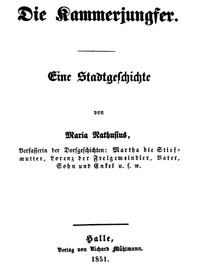
Die Kammerjungfer: Eine Stadtgeschichte by Marie Nathusius
Have you ever wondered about the lives humming quietly behind the grand doors of a historic home? Marie Nathusius's Die Kammerjungfer invites you to step over that threshold, not as a guest, but as a member of the staff. Published in 1857, this 'city story' feels remarkably immediate, pulling the curtain back on a world governed by strict hierarchy and unbreakable social codes.
The Story
The story follows Johanna, a young woman who becomes the lady's maid (or Kammerjungfer) for a well-to-do family in a German town. Her job is to be attentive, discreet, and nearly invisible. Through her eyes, we see the intricate machinery of the household: the polished routines, the subtle tensions between family members, and the complex relationships among the servants themselves. Johanna's position is unique—she is close enough to the family to observe their private struggles and ambitions, yet she remains firmly on the servant's side of an uncrossable line. The plot unfolds through her daily observations. A misplaced letter, a hushed argument overheard, a secret visit—these small incidents build a picture of a family, and a town, where reputation is everything and scandal is the ultimate fear. Johanna finds herself holding fragments of information that could upset the careful balance of her entire world.
Why You Should Read It
What grabbed me was how modern Johanna's perspective feels. She's not a passive observer; she's constantly thinking, judging, and navigating a system designed to keep her in her place. Nathusius, writing in the mid-1800s, shows a sharp understanding of the psychology of power. The drama isn't in sword fights or chases, but in a glance held a moment too long, or a piece of gossip shared at the right time. You read it thinking, 'This is how it really was.' The author doesn't preach; she simply shows the quiet injustices and the small dignities of a life in service. It’s a masterclass in showing, not telling.
Final Verdict
This book is perfect for readers who love character-driven historical fiction and social observation. If you enjoy novels about complex relationships and the hidden dynamics of a closed community—think Downton Abbey but with a tighter, more literary focus—you'll be right at home. It's also a fantastic pick for anyone interested in 19th-century literature from a woman's perspective. Die Kammerjungfer is a slow, thoughtful burn, not a flashy page-turner. It rewards you with a rich, authentic portrait of a time and place, seen through the keen eyes of someone who was supposed to see nothing at all.
This title is part of the public domain archive. Preserving history for future generations.
Christopher Miller
2 years agoThe citations provided are a goldmine for further academic study.
Charles Moore
2 months agoThe clarity of the introduction set high expectations, and the formatting on mobile devices is surprisingly crisp and clear. I'm glad I chose this over the other alternatives.
John Williams
4 weeks agoIt’s rare to find such a well-structured narrative nowadays, the language used is precise without being overly academic or confusing. A perfect balance of theory and practical advice.
Christopher Miller
7 months agoThe peer-reviewed feel of this content gives me great confidence.



Jennifer Anderson
10 months agoThis was exactly the kind of deep dive I was searching for, the chapter on advanced strategies offers insights I haven't seen elsewhere. Finally, a source that prioritizes accuracy over hype.