
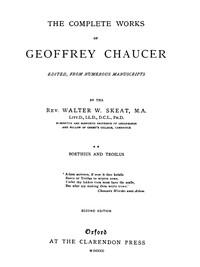
Chaucer's Works, Volume 2 — Boethius and Troilus by Geoffrey Chaucer
Let's be honest, most of us meet Geoffrey Chaucer through the rowdy, unforgettable characters of The Canterbury Tales. But Volume 2 of his collected works opens the door to a different, more introspective side of the poet. Here, we get two major pieces that show him not just as a storyteller, but as a thinker and a master of human emotion.
The Story
The book is split into two distinct parts. First, there's Chaucer's translation of The Consolation of Philosophy by Boethius. Imagine a Roman philosopher, imprisoned and awaiting execution, having a conversation with Lady Philosophy. She argues that true happiness isn't found in fame, wealth, or power—things fortune can take away—but in virtue and the love of God. It's a heavy, philosophical dialogue, but it sets the stage for everything that follows.
The main event is Troilus and Criseyde. Set in Troy during the Greek siege, it tells the story of Trojan prince Troilus, who mocks love until he's struck by an arrow from Cupid himself, falling for the beautiful and recently widowed Criseyde. With the help of her uncle Pandarus (a charismatic and meddling matchmaker), they begin a secret, passionate love affair. But their happiness is fragile. When Criseyde is sent to the Greek camp in a prisoner exchange, she promises to return. What unfolds is a devastating exploration of betrayal, broken promises, and the crushing weight of circumstances beyond our control. It's a complete, novel-length narrative of love found and lost.
Why You Should Read It
This is where Chaucer stops being just a historical figure and becomes a writer you can feel. In Troilus, he doesn't give us cardboard heroes and villains. Criseyde's decision to stay with the Greek Diomede isn't painted as simple treachery; Chaucer shows us her fear, her isolation, and her heartbreaking practicality. Troilus's grief is palpable and obsessive. The poetry itself is stunning—full of tender moments, witty dialogue from Pandarus, and profound sorrow. Reading it, you realize he was exploring psychological depth and moral ambiguity centuries before it was cool. The Boethius translation, while denser, is the key that unlocks the themes of the romance: it asks the big questions about fate, free will, and where to find solace in a chaotic world that the characters in Troilus are desperately living through.
Final Verdict
This isn't light bedtime reading. It's for the reader who wants to go beyond the famous tales and meet the real Chaucer. Perfect for lovers of classic literature who enjoy deep character studies, for anyone interested in the roots of the English novel, or for people who just love a tragically good, complicated romance. If you enjoyed the humanity in Shakespeare's plays or the emotional stakes in a novel like Wuthering Heights, you'll find a kindred spirit in this 14th-century poet. Get ready to have your heart broken by a 600-year-old story.
This content is free to share and distribute. Thank you for supporting open literature.
Logan Hernandez
1 year agoWithout a doubt, the arguments are well-supported by credible references. I will read more from this author.







Karen Garcia
1 year agoI came across this while browsing and the plot twists are genuinely surprising. One of the best books I've read this year.