1

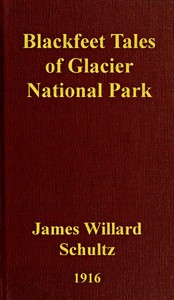
Blackfeet Tales of Glacier National Park — Text and Context
3
1
Project Gutenberg
2013
Indians of North America -- Folklore; Siksika Indians -- Folklore; Glacier National Park (Mont.)
Readers of public-domain and historical texts
Project Gutenberg digital edition
en
Edition facts
Words: 50,579
Reading time: 220 min
Text sections: 6
Source:
Project Gutenberg record #43399
Schultz's collection of Blackfeet narratives set in Glacier National Park blends firsthand accounts with tribal lore, revealing how place names and landscapes anchor stories of war, marriage, and supernatural medicine.
Editorial Edition Score
4.7/5
★★★★★
★★★★★
Calculated from edition completeness, EPUB availability, text structure and catalogue metadata. Not a user rating.
Edition quality
James Willard Schultz, who lived among the Blackfeet and married into the tribe, frames these tales as stories told to him by elders Tail-Feathers-Coming-over-the-Hill and Yellow Wolf during a camping trip. The opening scene—gathering in Yellow Wolf's lodge, lighting the pipe—establishes a listening context that recurs throughout. Schultz does not simply transcribe; he presents himself as a participant, noting that the storytellers selected which tales to share. The result is a volume that documents both the narratives and the social setting of their telling.
Place Names as Story Anchors
The book is organized by geographic region—Two Medicine, Cutbank, St. Mary’s Lakes—and each tale is tied to specific landmarks. In “New Robe, the Rescuer,” the Crow camp is located “right here where we are encamped to-night,” linking past and present. The narrative voice repeatedly glosses Blackfeet place names: Ap-ut′-o-sosts O′muk-at-ai (Big River of the North) is identified as the Saskatchewan, and River-of-Many-Chiefs-Gathering as the St. Mary’s River. These annotations reveal how the landscape functions as a mnemonic for tribal history, though the excerpts do not clarify whether Schultz’s informants endorsed every toponymic claim.
Social Status and the Quest Plot
Several tales hinge on a low-status protagonist who wins recognition through a dangerous journey. New Robe is “so poor … he had never owned a new robe”; his love for Red Cloud Woman is hindered by poverty. The quest for her lost brother becomes a means to prove worth. The girl’s vow to marry the rescuer, and her admission that she “had watched you, loved you for a very long time,” sets up a romance that the excerpt leaves unresolved. This pattern—a marginal figure elevated by courage—appears in other stories (e.g., “How Mountain Chief Found His Horses”), suggesting a recurring narrative structure that rewards perseverance over birth.
The Ethnographic Frame: Schultz’s Role
Schultz inserts himself into the narrative as a listener and scribe, but the excerpts show him shaping the material. He tells the elders he “could not put them all down—could use only two or three of the most interesting ones,” implying editorial selection. The dedication to Louis Warren Hill, who made Glacier National Park “accessible to the American people,” hints at a dual audience: Blackfeet tradition-bearers and non-Native tourists. Schultz’s footnotes (e.g., identifying the Saskatchewan) serve a non-Blackfeet reader. The catalog subject “Indians of North America—Folklore” fits, but the excerpts emphasize that these are not timeless myths; they are situated, negotiated accounts from specific individuals in a specific time.
Readers should attend to the interplay between Schultz’s editorial voice and the Blackfeet narrators’ voices. The tales are not presented as unmediated folklore; they are framed by Schultz’s presence, his choices of which stories to include, and his explanatory notes. Noticing when Schultz steps in—to gloss a name, to describe a ceremony, to mention his own limitations—reveals the collaborative, partial nature of this record. The book is best approached as a document of cross-cultural encounter, not a transparent window onto Blackfeet tradition.
Reader reflection
How will you remember this book?
Save your reaction, strongest insight, and memorable passage.
Your progress
0
/
10
2
Was reading this book enjoyable?
3
Would you recommend this book to another reader?
4
What was the reading difficulty like?
5
How strongly did the book affect you emotionally?
6
Did the book give you something worth debating?
7
Was the book moving at the right speed?
8
Which aspect of the book did you value most?
9
What did this book teach you most?
10